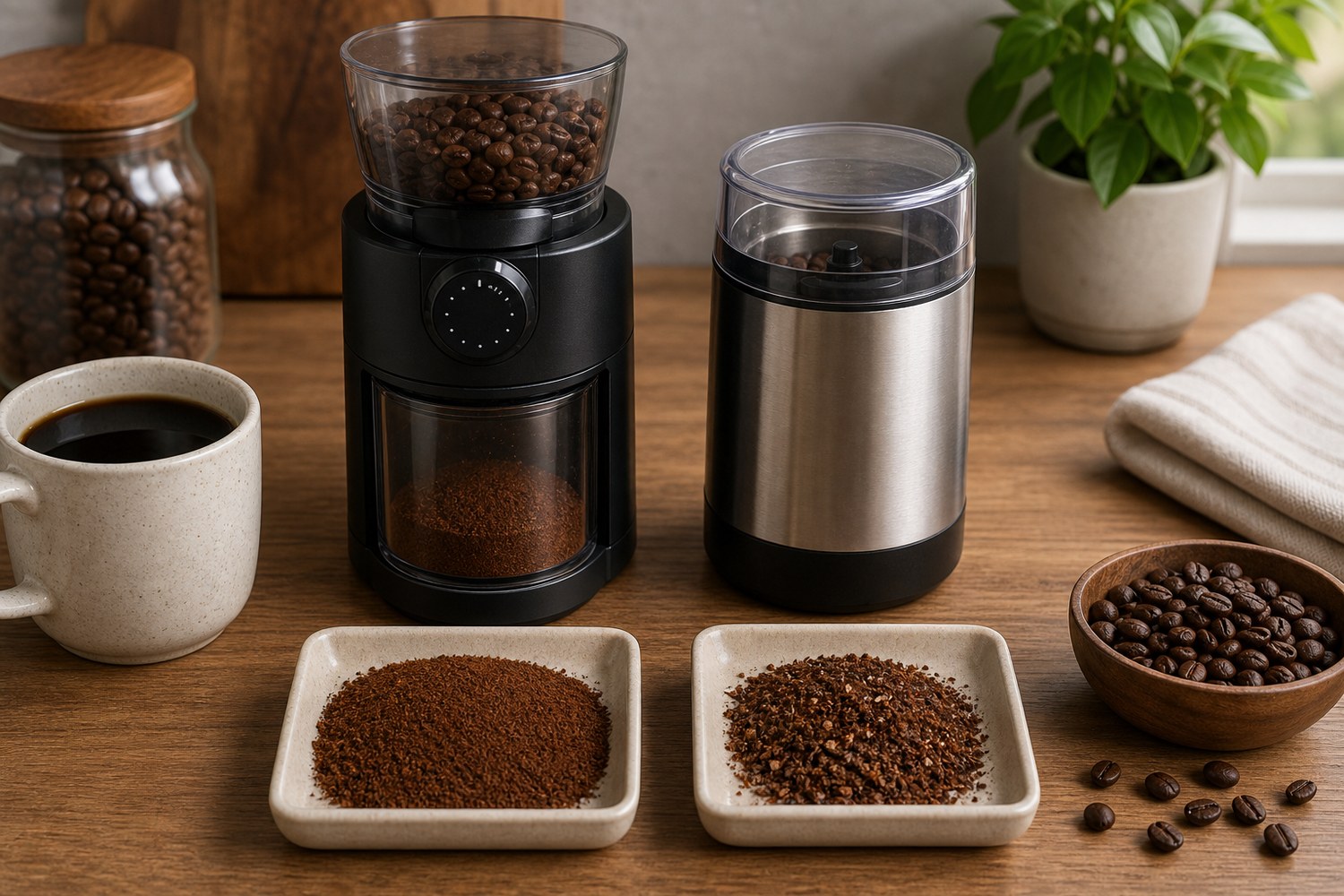
If you’re aiming to up your coffee game, one of the first pieces of advice you’ll hear is: get a burr grinder. But why? Let’s compare burr grinders vs blade grinders and explain how they impact your coffee’s flavor and consistency.
How They Work:
- Blade Grinder: This is like a little blender or propeller. It has metal blades that spin rapidly and chop the coffee beans. There’s no mechanism to ensure even particle size – beans get bashed around and cut randomly. If you hold the button longer, you get “finer” grounds, but really you end up with a mix of powder and chunks (inconsistent). Think of chopping vegetables with a knife haphazardly – you’ll get big and small pieces.
- Burr Grinder: Uses two abrasive surfaces (burrs) – either flat disks or conical – that crush the beans to a specific size. You set a gap between the burrs; beans fed through get ground more uniformly to that size. It’s more like milling. This yields a much more uniform particle size and you can control the size by adjusting burr spacing.
Consistency & Why It Matters:
When brewing, even extraction is key to good flavor. If some coffee particles are very fine (dust) and others are coarse chunks (boulders), the fines will over-extract (bitter, harsh) and the boulders will under-extract (sour, weak). The result is a muddled flavor – often simultaneously bitter and sour, missing clarity and sweetness. This is what happens with blade grinders. You get fines (muddy sludge, over-extracted bitterness) and boulders (under-extracted weak parts). Burr grinders produce a more consistent grind, so all particles extract at similar rates, yielding a more balanced, predictable flavor.
Flavor Impact:
- Blade Ground Coffee: Tends to have less clarity and more bitterness. For example, a French press with blade-ground coffee often has lots of sludge (fines), making it overly bitter or chalky. A pour-over with blade grounds might clog from fines and drip very slow (over-extracting some), but also let water channel past the large bits (under-extracting others) – leading to a dull or off-tasting cup. You rarely get the bright high notes or sweet nuances because they’ve been obscured by uneven extraction.
- Burr Ground Coffee: Typically results in better tasting coffee – more of the desirable flavors and proper strength. You’ll notice brighter acidity when appropriate, smoother sweetness, and controlled bitterness. Essentially, you can hit the brew target more precisely (18-22% extraction yield for optimal flavor, in coffee science terms). The cup will have fewer unpleasant extremes (sour/bitter) and more harmonious flavor. It’s the difference between a stew where all veggies are uniformly cooked vs. one where some are raw and some mushy.
Grind Size Options:
- Blade: You can somewhat control by pulsing and how long you grind (short = coarse-ish, long = more fine). But you can never achieve true coarse consistency for French press – you’ll always have a lot of fines that slip through and over-steep. Nor can you get very precise for espresso – you might manage a fine grind, but it’ll be uneven, leading to channeling in the espresso puck and inconsistent shots.
- Burr: You get adjustable settings. Want medium-fine for pour-over? Dial it in. Need coarse for cold brew? Easy. Espresso fine? A good burr grinder can do it and with uniformity. This repeatability and control is crucial for dialing in brew recipes. Burr grinders also produce less heat and friction on beans than whirring blades (if using a quality burr grinder), preserving aroma.
Static and Mess:
Blade grinders often create static cling and coffee dust that sticks to the grinder and makes a mess when opening the lid. Burr grinders, especially good models, design paths to reduce static (though some static can still happen). Many burr grinders also have a bin that neatly catches grounds, making it easier to pour into your brewer.
Capacity & Speed:
Blade grinders usually only allow a small amount at a time and you kind of eyeball the grind. Burr grinders can handle larger batches (some have hoppers for many ounces of beans) and grind fairly quickly and uniformly.
Longevity and Investment:
Blade grinders are cheap (often $15–$30). They have one function and often not built to last long (though not much can break except motor eventually). Burr grinders range from ~$40 hand-crank models to hundreds for electric. It’s a bit of an investment, but even an entry-level burr grinder (hand or electric) will outperform a blade in grind quality. They also allow you to brew coffee styles that blade grinders simply can’t do well (like espresso or Turkish which need very fine consistent grind).
Versatility:
Blade grinders sometimes double as spice grinders, etc. But that’s a negative for coffee because grinding spices can leave residual flavors (unless you have separate units or clean thoroughly). Burr grinders are dedicated to coffee typically. If you are tempted to use a blade grinder for spices and coffee – don’t with the same unit, unless you want cumin-flavored coffee!
Noise:
Both can be noisy. Blade grinders have a high-pitched whir; burrs have a lower gear-like sound. Both are brief though. No major difference here except some high-end burrs are designed to be quieter.
Case Study – French Press Example:
With a blade grinder: You’ll likely end up with sediment and perhaps need to strain or deal with bitter aftertaste. The press might be sludgy. With a burr grinder: You can get a nice coarse grind, resulting in a cleaner French press (still full-bodied but not overly silty) and easier to press (blade grind’s fines often clog and make pressing hard). The taste difference is huge – burr-ground press will have more clarity and sweetness, and you can actually experience that nice oily big body without as much bitterness.
Espresso Example:
Blade grinder for espresso – extremely hard to dial in, likely channeling and inconsistent shots each time (maybe one time it chokes, next time it gushes, due to inconsistency). Burr grinder – you can find the sweet spot where your shot pulls right and the flavor is balanced.
Pour-over Example:
Blade: Water likely drips through too fast in some spots and too slow in others because of uneven grind, yielding either a flat or sour cup with some harsh notes. Burr: Even flow, predictable brew time, complete extraction – vibrant and pleasant cup.
Bottom Line:
A burr grinder is one of the best upgrades for any coffee brewing, arguably more important than a fancy brewer. Freshly burr-ground coffee will almost always outshine pre-ground coffee (even good pre-ground loses aroma) and blade-ground coffee. The consistency leads to better extraction and thus tastier coffee. Blade grinders are okay in a pinch (better than nothing if you have whole beans and no other way), and some people use them for drip with tolerable results, but once you taste the difference or do a side-by-side, it’s hard to go back. As coffee guru Scott Rao quipped, “Using a blade grinder is like chopping your coffee with a machete.” For the serious (or even semi-serious) coffee lover, burr grinders are absolutely worth it.
Investing in a burr grinder means you’re taking control of a crucial aspect of brewing – grind size and consistency. It might seem like a technical detail, but as soon as you brew with burr-ground coffee, you’ll taste the improvement in smoothness, balance, and overall enjoyment of your cup. It truly matters!