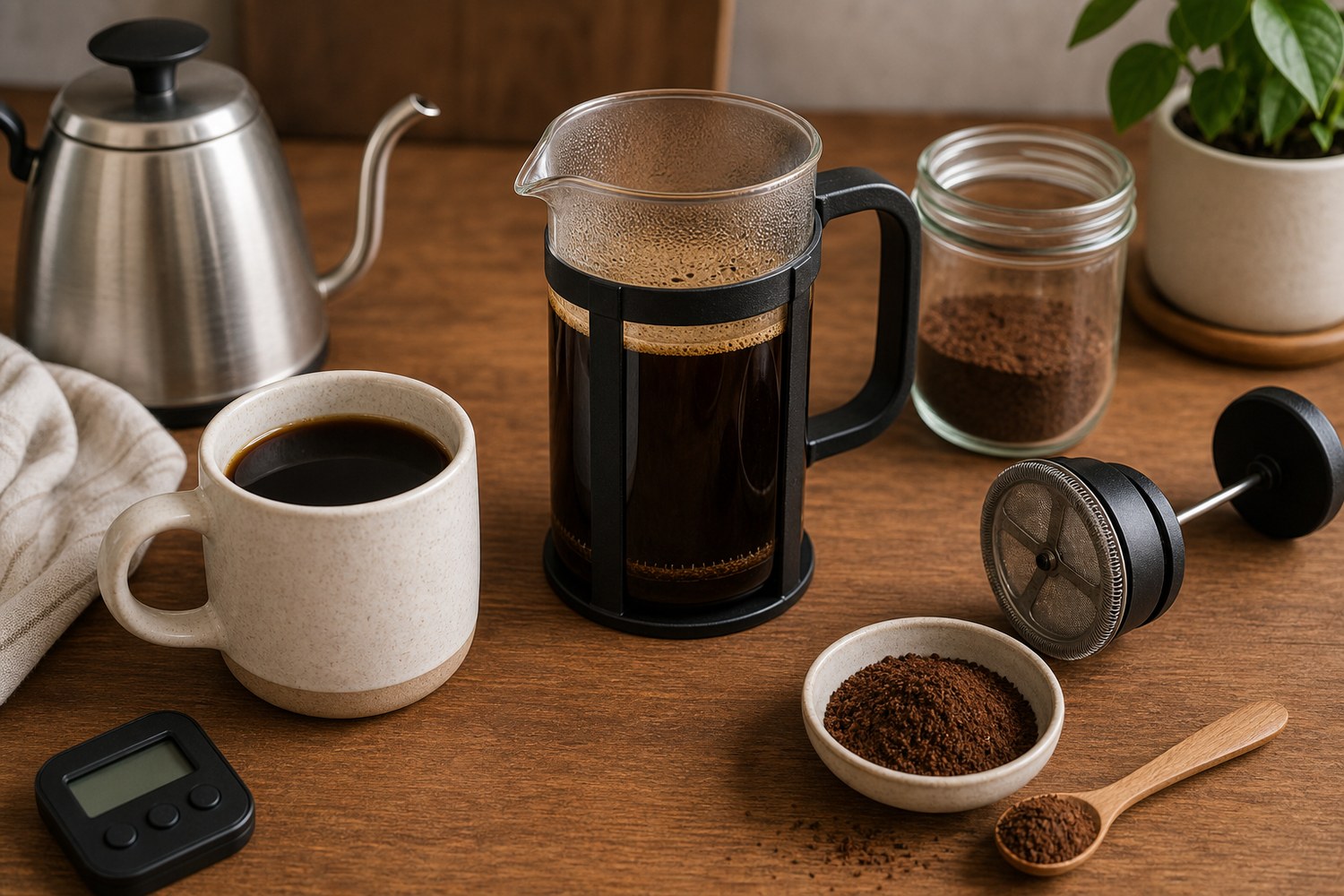
The French press is often one of the first coffee brewers people use, known for its simplicity. But as an intermediate coffee lover, you can go beyond the basic “add hot water and wait” method. By tweaking your technique, you can improve clarity, reduce grit, and highlight the rich flavors without the excessive bitterness or sediment that sometimes plagues French press coffee. Here are some advanced tips and techniques for a superior French press experience.
1. Choose the Right Grind (and Amount):
Classic advice is to use a coarse grind for French press. While coarse is standard to avoid too many fines, many experts now suggest using a medium or medium-coarse grind and adjusting other variables to get a cleaner cup. A slightly finer grind than usual can improve extraction and flavor complexity, but be cautious: too fine and you’ll have a silty, over-extracted brew. Aim for something like sea salt or breadcrumbs texture. For dose, a common ratio is 1:15 – for example, 40g coffee per 600g (≈600ml) water for a full 8-cup press. You can adjust strength by using a bit more or less coffee to taste.
2. Water Temperature Matters:
Use water around 200°F (93°C) for French press (just off boil). Because French press is full immersion, a slightly lower temp than boiling helps avoid over-extraction during the several-minute brew. If coffee tastes overly bitter or ashy, your water might be too hot – try ~195°F. If it’s a bit sour/thin, go closer to 205°F. (Most times, kettle off boil for 30 seconds is fine).
3. The Bloom and Stir:
Just like pour-over, blooming can help. Add just enough hot water to saturate the grounds (they should all be wet) – maybe about twice the weight of the coffee (e.g. 80g water for 40g coffee). Wait ~30 seconds. You’ll see bubbles of CO₂ escaping if your coffee is fresh. Then give a quick stir to mix the bloom. This ensures all grounds are wet and helps with even extraction.
4. Fill and Don’t Plunge Yet:
After blooming, pour the remaining water to reach your target volume (e.g., up to 600g). Give it a gentle stir again to make sure all grounds are swirling and not clumped. Now here’s a pro tip: take a spoon and scoop off the top layer of foam and floating fine grounds and discard them. This skimming removes some of the fines that would otherwise settle or muddy the cup. It also reduces that “crusty” layer that can taste bitter. Many baristas do this in competitions for cleaner brews.
5. Extended Brew or Two-Stage Steep:
Standard French press brewing time is about 4 minutes. However, some advanced methods use a two-stage steep:
- Let it steep ~4 minutes, then gently break the crust and give one last stir. This knocks down grounds.
- Then let it sit an additional 5-6 minutes with the lid on but not plunged*. During this time, most of the grounds settle to the bottom on their own (gravity is your friend). This essentially separates a lot of fines from the liquid.
This technique, often called “French Press Sweep and Settle,” can dramatically clarify the brew. It was popularized by coffee professional James Hoffmann. The idea is you’ll later pour without disturbing settled grounds, and potentially not even plunge at all (or plunge just to act as a strainer while pouring).
6. The Gentle Plunge (or No-Plunge Pour):
After your total brew time (4-8 minutes depending on method), it’s time to separate grounds from coffee. If you followed the settle method above, you might find plunging unnecessary – you can carefully pour the coffee out through the filter, not letting the sludge at bottom escape. If you do plunge, do it slowly and steadily with minimal force, just until the mesh meets the grounds. A hard, fast plunge can agitate grounds and push more fines through the filter. You’re not trying to compress the grounds strongly – just separate coffee from grounds.
7. Don’t Leave Coffee in the Press:
As soon as you’ve finished brewing and plunging, decant the coffee into cups or a carafe/thermos. If coffee sits on the grounds longer, it will continue extracting and turn bitter. Even with the plunger down, the coffee at bottom is still in contact. So pour it all out relatively soon. This is a common mistake – people leave leftover coffee in the press on the counter, which over-extracts and becomes harsh.
8. Deal with Sediment:
No matter what, French press tends to have some sediment. Using the techniques above (slightly finer grind + skimming + settling) greatly reduces it. Another hack: after plunging, pour through a secondary small filter (like a fine tea strainer or even through a paper filter placed in a funnel) for an ultra-clean cup. This might be overkill for daily use, but it’s an option if you want clarity comparable to drip. Some newer French presses also have double micro-filters (like Espro Press) that remove more fines while pressing.
9. Experiment with Ratios and Time:
If your French press brew is too strong or sludgy with the above, try a slightly coarser grind or shorten brew to 3 minutes before settling. If it’s too weak or sour, grind a bit finer or extend to 5 minutes. French press is forgiving and flexible once you’re in the right ballpark. Adjust to taste. Remember, a well-brewed French press should taste rich and full-bodied, but not overly bitter or silty.
10. Cleaning the Press:
To keep flavors fresh, clean your French press thoroughly after each use. Oils can build up on the glass and filter mesh and turn rancid, imparting off flavors over time. Disassemble the plunger parts occasionally and give them a deep clean. A mixture of baking soda or a coffee-specific cleaner (like Cafiza) can help remove stubborn coffee oils from the mesh screen.
Putting It All Together – An Advanced Recipe Example:
- Coffee: 30g medium-coarse (slightly finer than usual)
- Water: 450g at ~200°F
- Bloom with 60g water, 30 seconds. Stir.
- Add remaining 390g water to 450g total. Stir gently.
- At 4:00, use two spoons to skim off floating foam and grounds. Discard them.
- Place plunger lid on top but do not plunge. Let coffee sit undisturbed for another 5 minutes (until 9:00). Grounds will mostly settle at bottom.
- At 9:00, slowly press the plunger just to the top of the liquid (or even skip pressing).
- Pour coffee out slowly into cups, leaving the last 1/2 inch of coffee in the press (where the heavy sludge resides). You’ll have a very clean cup for French press – lots of body and oils, minimal grit.
This method yields a wonderful, robust cup without the usual drawbacks. It might seem long, but the extra wait is passive – you can be doing something else while it settles. Many find the quality improvement worth it for weekend brews when not in a rush.
However you choose to do it, French press can produce stellar coffee that highlights body and sweetness. By applying a few advanced tricks, you’ll impress your taste buds (and your friends) with how refined a French press brew can be. Happy pressing!